

Hollywood shop owner has devoted his life to sharing the culture and language of Nepal
When Daya Shakya was a teenager, his father’s guru delivered a prophecy that no parent could ignore. Your son will not spend his life in their native Nepal, the guru told Shakya’s father. Instead, he will go on to become world famous for his service to humanity.
His father was trying to decide if he should take his son to India to study. It would be quite a departure from the path they’d envisioned for him, working alongside his father as an artisan in Kathmandu. But 16-year-old Shakya had an aptitude for learning and language, and needed more opportunities to explore.
But whether through destiny or disposition, his path would play out as prophesied. He would indeed live a life of notoriety, knowledge and humanitarianism, becoming known across continents for his work preserving and promoting Nepalese culture, language and literature. The journey would take him through academic institutions, leadership halls, community centers and the publishing world — all the way to the Himalayan Gifts and Candy Store, the shop he operates with his wife inside 42nd St. Station in Hollywood.
“I thought, ‘how can this [prophesy] be possible?” he said. “But one event after another took me over here.”
From Nepal to 42nd St. Station
The story of how Shakya ended up in Oregon is one of international camaraderie and the collective pursuit of knowledge. A handful of Nepalese students had studied at the University of Oregon in 1958, which kicked off a cultural exchange that would result in them founding the Tribhuvan University in Nepal, a sister city relationship between Eugene and Kathmandu and the no-longer-improbable opportunity for Shakya to continue studying linguistics at UO.
By then, he already spoke a handful of languages, and would eventually be able to communicate in Nepali, English, Hindi and Tibetan, as well as knowledge of Sanskrit and German. But it was his first language, that of the Newar people, that would be the subject of his life’s work.
The Newars are indigenous to the Kathmandu Valley in Nepal, with a distinct language and cultural history from other groups in the foothills of the Himalayas. Their language is linguistically closer to Japanese and Chinese than the more commonly spoken Nepali, and has been officially designated an endangered language. According to a UNESCO report, just over 800,000 people spoke it in 2010, and a 2001 paper stated that more than a third of Newar people have given it up entirely.
As a child, Shakya knew his language as “Newari,” but later came to understand that the term carried with it a history of conquest and discrimination. The correct term for the language is Nepal Bhasa, which translates to “Nepal language.”
It was Shakya himself who played a key role in this shift. He wrote a paper in 1997 called “In Naming a Language,” which he presented at a conference that changed everything.
“Attended by many of the top Himalayan linguistic scholars in the world, the presentation and publication of this paper had an immediate effect,” wrote David Hargreaves, Emeritus Professor of Linguistics at Western Oregon University in a forward to one of Shakya’s books. “[This was] directly responsible for introducing to western linguistics the term “Nepal Bhasa,” as the proper term for referring to the language.”
Nepal Bhasa was repressed for much of the 20th century, and has survived only through the persistence and passion of people like Shakya.
“I always tell people, do not give up speaking your own language with your children,” he said. “They’ll learn English from school and society, but learning your own language must start from home.”
A shopkeeper and a scholar
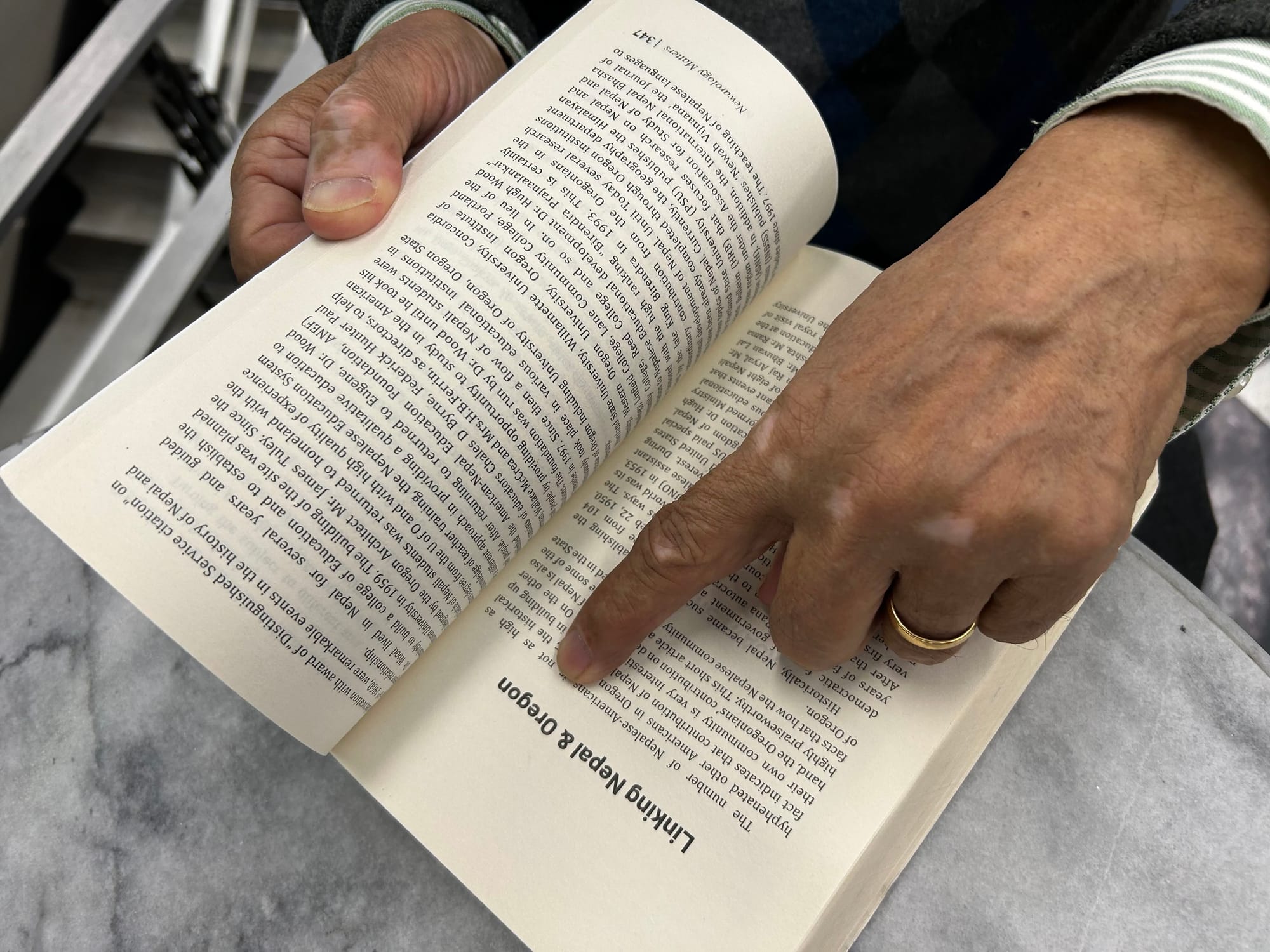
With his wire-framed glasses and argyle sweater, Shakya is in many ways the picture of a scholar as he discusses his life’s work in the bustling lobby of the 42nd Street Station. His voice is soft yet authoritative and he casually incorporates linguistic deep-cuts and historical facts into the conversation. A copy of Newaralogy Matters, a collection of his many essays and academic papers, lies nearby.
Shakya has taught Nepal Bhasa and other languages of the region at learning institutions across western Oregon. Teaching roles led to leadership roles, and Shakya has been heavily involved in Nepalese community groups for decades. He has been vice president of the Newah Organization of America, director of the Center for Nepalese Language and Culture and president of the Nepalese Association of Oregon — twice.
These days, he has expanded his work to focus on translation and interpretation, working in medical and legal settings to help people navigate complex systems in a language they understand. Just the other day he was called in on a legal matter so complicated it took him two hours just to understand the details so he could help the person in need.
“I always help people out, whether I get the benefit or not,” he said. “Helping people with compassion comes from my own heart.”
And, of course, there’s the Himalayan Gifts and Candy Store, which he started as a side business when he realized people in the U.S. were interested in Himalayan goods. He started bringing things back from Nepal in suitcases, and expanded to selling at fairs. He and his wife, Jaya, took over the store in Portland from a previous owner in 2006.
Being busy is just part of who he is, and he’s always finding new ways to live his values. He wishes he could slow himself down and just watch a movie on the couch with his wife, but there is always another person to help or an idea to explore. He may even publish another volume of Newarology Matters.
“I always think that just keeping the knowledge within me; that’s not a good idea,” he said. “Whatever you know, you need to share with other people.”
For more information about Newarology and Shakya’s work, visit www.newarology.world
Want to learn a few phrases in Nepal Bhasa? Daya Shakya has translated some key conversation starters so Star News readers can help keep the language alive.
“Well, it looks like the rain is back.”
“Liu-ne, Liu-ne, waa wayaa chona then chon.”
"Hello Daya! I read the story about you in the Star News. My name is ____."
“Jojolapaa Daya! Chhigu baakhan Star News san bonaa jigu naa ____ kha.”
"Keep Portland Weird"
“Portland Shahar ajib yaanaa ti.”
— By Lisa Heyamoto, Star News contributor


